
The Forbidden Empire: What lies hidden in the 99% of the Paris Catacombs off-limits to tourists?
The forbidden empire
What lies hidden in the Paris Catacombs?

The city of bones
You have probably heard of the famous Paris Catacombs. Maybe you have even visited them. But did you know that the official tour is only a tiny piece of the puzzle? The part open to tourists is just a safe, well-lit 1.5-kilometer path. Right past the locked gates lies the true underworld. Stretching into the pitch-black void is a 300-kilometer maze of secret tunnels.
So, why is the public only allowed inside that one tiny section?
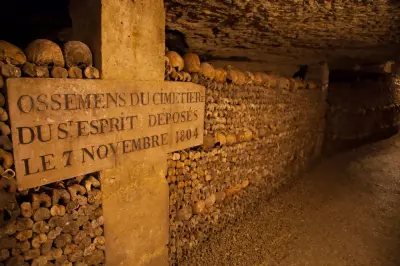
It all comes down to safety. Descending 20 meters below the city streets, this massive underground world is actually an ancient system of underground limestone quarries. It holds the bones of over six million Parisians, moved there back in the 1700s when the city’s overflowing cemeteries started causing a major health crisis. The official bone ossuary covers roughly 11,000 square meters. The remaining part of the forbidden tunnels is mostly empty, silent stone corridors. Beyond the heavy museum gates, the ancient limestone tunnels are crumbling, flooded, and prone to sudden cave-ins, too dangerous for the public.

How a public health crisis built the Catacombs
To understand why these catacombs exist, we have to look back at 18th-century Paris. The city had a massive public health crisis: its cemeteries were completely overflowing. The worst spot was Les Innocents Cemetery. The ground became so oversaturated with decomposing remains that it polluted local water wells and created a toxic, foul stench across the city. The emergency reached a breaking point in 1780 when heavy rains caused a cemetery wall to burst, spilling rotting corpses. Following earlier decrees by King Louis XV to ban inner-city burials, the severe crisis forced King Louis XVI to finally take drastic action. In 1786, the city began moving the remains into the abandoned underground limestone quarries, officially creating the Catacombs.
If you’ve ever wondered exactly how many bodies are in the Paris catacombs, the staggering answer is roughly six million. Moving them was a massive, eerie task that took years to complete. Every night, heavy carts loaded with bones rolled through the dark streets, led by priests chanting prayers. Today, this giant graveyard forms the literal foundation holding up modern Paris.

Exploring the underground: Cata-flics vs. Cataphiles
The 300 kilometers of unmapped tunnels are dangerous and strictly off-limits. To manage the underground subculture of Cataphiles, the Parisian police formed a specialized unit, affectionately dubbed the “Cata-flics” (catacomb cops). Armed with high-powered flashlights, waterproof thigh-boots, and top-secret maps, these specialized officers spend their shifts patrolling the pitch-black maze.

What do the Cata-flics actually do in the dark?
- Hunting trespassers: They track down the “Cataphiles” (urban explorers who sneak inside to hang out, paint murals, or map the tunnels). If the police catch you, you won’t go to jail, but you will get a fine and an escort back to the surface.
- Saving lives: This is their most critical job. People who sneak in without a guide could easily get lost. The Cata-flics are trained to track down stranded thrill-seekers before their flashlights run out of batteries.
- Blocking entry: The police constantly search for new ways people use to break into the network, such as unlocked manhole covers, subway vents, or hidden basement doors, and lock them down.
Aside from lost tourists, the Cata-flics frequently discover underground art galleries, secret bedrooms with sleeping bags, and even the leftovers from illegal underground parties.

Myths vs. reality: secret cinemas and wine heists
The hidden tunnels are surrounded by wild rumors, but some of the craziest stories are completely true. People have used the deep maze for far more than just exploring.
- The Secret Cinema (2004): Police on a training mission beneath the Trocadéro plaza stumbled into a massive 400-square-meter room. Inside, an underground art group had stolen electricity from the city grid to build a fully functioning movie theater, complete with a giant screen, a bar, and a restaurant. When police returned a few days later to tear it down, everything was gone. The group left behind a single note on the floor: “Do not try to find us.”
- The Great Wine Heist (2017): Thieves pulled off a movie-style robbery using the tunnels. They navigated directly underneath a luxury apartment building, drilled upward through the soft limestone, and broke into a private cellar. They packed up over 300 bottles of ultra-expensive grand cru wine worth €250,000 and disappeared back into the dark maze. To this day, no suspects have ever been identified.
INTERESTING FACT
Long before modern “Cataphiles” started throwing illegal parties underground, 19th-century French high society pulled off the ultimate secret gig.
In the spring of 1897, the Paris Catacombs became a secret midnight concert hall. A small group of musicians and writers received secret invites to an underground concert. Once inside the deep, bone-lined tunnels, the guests were treated to a full, live orchestra performance. Right there in the dark, surrounded by millions of skeletons, the musicians played thematically perfect classical pieces like Chopin’s Funeral March and Camille Saint-Saëns’ Danse Macabre. It remains one of the most famous, eerie, and exclusive underground concerts in Parisian history.


Why did Paris lock away a 300-kilometer maze?
The short answer is that fixing them looks unrealistic. Trying to repair and reinforce hundreds of miles of old, crumbling stone is expensive, so the tunnels were left in the dark. However, that doesn’t mean they are forgotten or neglected. Paris actually has a dedicated team of engineers who monitor the underground network to keep the streets above from collapsing. If a tunnel section weakens and threatens a building on the surface, crew members go down and pack it with concrete to stabilize the ground. Now and then, city planners debate turning a few small, accessible spots into new urban projects. But for the most part, the plan won’t change for now. The vast majority of the network will remain sealed off, just a quiet foundation supporting the bustling city above.

Are there actual plans to do something down there?
Aside from the official city plans, experts are debating how to handle the maze’s hidden part. The discussions and strategies revolve around public safety, geological structural failures, and maintaining street stability.
Using tech to find empty spaces: Engineers want to use flying drones and high-tech 3D lasers to map the hidden tunnels. This helps them find weak spots before the ground collapses and creates dangerous sinkholes in the streets above.
Saving history vs. filling holes: When new buildings are built on top, experts debate how to preserve the underground space. Filling the tunnels completely with concrete is cheap and safe, but it destroys history; building stone pillars saves the tunnels but is very expensive and risky.
Better security: To keep illegal trespassers out and watch for moving rocks, experts want to install automatic motion sensors and underground alarms instead of just sending human guards down to check.
New green uses: Some planners are discussing using the safe, sturdy parts of the tunnels for modern needs, such as capturing underground heat for buildings or storing extra rainwater during big storms.

The future below
Paris is currently building the Grand Paris Express, a massive new subway expansion that will run through 2031. Because these giant train lines have to dig deep underground, engineers are actively mapping the ancient quarries. To prevent the city streets from collapsing during construction, the weakest empty pockets are filled with reinforced concrete.
INTERESTING FACT
According to official authorities, there are no modern records of anyone dying from getting lost or injured in the Paris Catacombs. In fact, the only officially documented death from getting lost in the maze is a historical one. In November 1793, a hospital worker named Philibert Aspairt vanished into the darkness, and his body was only discovered eleven years later (a fact still verified by his 1804 death certificate in the Paris archives).
While people still occasionally get lost exploring the forbidden, unmapped sections of the tunnels today, most notably two teenagers who were lost for three freezing days in 2017, they are successfully rescued by authorities. To prevent historical tragedies like Philibert’s and modern injuries, the legal 1.5-kilometer tourist path is closely monitored, strictly managed, and carefully mapped by museum officials and the French government.
Why is the official path the only path?
The hidden 99% of the Paris Catacombs will always be shrouded in mystery and wild urban legends. However, while this forbidden 300-kilometer maze is fascinating, it is dangerous to explore. Without proper lighting, reliable maps, or ventilation, the risk of getting lost, injured, or trapped by a sudden cave-in is dangerously high.
That is why the official 1.5-kilometer tourist route remains the best way to experience this underground world. While it may only represent 1% of the vast network, it is the only safe and responsible way to explore it.
Also, the Parisian Catacombs are, first and foremost, a historic mass grave. Exploring the maintained path ensures the remains of the six million Parisians resting below are treated with the solemnity and respect they deserve.
PRO TIP
Want to experience the eerie history of the Catacombs for yourself? Join our Catacombs Paris Tour to skip the lines, hear more incredible stories, and safely explore the famous Parisian ossuary.
Check out our Catacombs Paris Tickets to secure your spot!
Planning a trip to Paris soon?
Make the most of your trip and your descent underground with our expert travel guide.

We have the best value Paris tours & tickets for you!

Priority access
Louvre Museum Ticket
With this ticket, you will get priority access to the entrance to the Louvre Museum in Paris. Don’t miss the opportunity to discover numerous impressive artistic masterpieces, including the iconic Leonardo da Vinci’s Mona Lisa. Feel free to stroll around the museum and marvel at different artworks for as long as you like.

City pass
Paris Pass
Save your time and money by purchasing this best-selling Paris Pass. Enjoy privileged access to the main attractions and museums in Paris. With this ticket, you will be able to visit Eiffel Tower, take a Seine River cruise, go on the Louvre Museum self-guided tour, and much more!

boat tour
Paris Seine River Cruise
See Paris’s iconic sights while enjoying this incredibly relaxing River Seine cruise. Listen to an audio guide and learn something new about the world’s best-known landmarks, such as Notre Dame, Louvre Museum, and Eiffel Tower. Take advantage of this unique opportunity to see the entire city without having to walk!